WINNER OF THE BOCCACCIO PRIZE IN ITALY
'Saniee gives a voice to all the Iranian women who are victims and prisoners of domestic violence, tradition and men's abuses... Saniee's women are contemporary heroines who fight to obtain civil rights even if that can cost them their lives.' Cultura, Italy
'Delightful and frank. A bold and sincere portrayal of injustices so masterful that no oppressive court can logically or openly ban its publication. Tyranny openly admissible in backward societies towards women and yet the overwhelming protection offered to men by the "current tradition" are articulated through fictional characters. From start to finish, it is a privation tale of Iranian women who will not give up and continue to strive for their rights.' Bokhara Magazine, Iran
'A fresh slice of world literature for spring, starting with Iran’s bestselling novel of all time,The Book of Fateby Parimoush Saniee : a tale of forbidden love set amid the upheavals of the sociologist author’s native country.' The Sunday Telegraph, UK
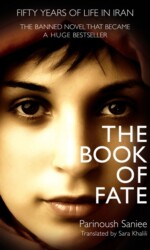
This is a story of an Iranian girl who finds love on her way to school. When found out, she is forced into marriage to a political dissident during the last days of the Shah’s regime but is widowed soon after when her husband is executed at the hands of the new regime. When after 32 years her first love reappears, she is faced with indignation from her 3 grown up children, two of whom live abroad. Should she put her own feelings first or those of her children?
This is an extremely moving and powerful tale of women in Iran, beginning before the revolution of 1979 through the Islamic Republic to the present. Spanning five decades it tells the story through the changing fortunes of one family and in particular of Massoumeh, the daughter. Through the highs and lows, having children and finding work (and losing it again because of political change), the changing attitudes in Iran are vividly depicted through the characters. This is a window on recent Iranian history untainted by ‘western interpretation’ making it that much more fascinating and revealing. It is a story of strong women fighting for what they want against huge odds, a story of friendship and passion, of religious oppression but also of love for the country.
Though it was banned twice by the Iranian regime, it has now been reprinted over 20 times and is at the top of the best ever selling books in Iran. Already published to great acclaim and success in Italy where it won the Boccaccio prize for the best international book
‘Parinoush in very simple language has written a sociological novel. It awakens our collective memories and brings back to life those we have long forgotten.’ Universe of Books, Iran
'The writer pushes through the personality of her characters through time and historical events that many storytellers often do not dare to mention. Not content with tribulations during the revolution, she takes the fate of her heroine’s spouse through barbed wires and to today’s political slaughterhouse.’ Hemlock Magazine, Iran
'A sensation' from Iran' Dagbladet, Norway
'A gripping tale' VG Norway
'An important book' Aftenposten Norway
‘With fantastic skill and sharp observations, Saniee paints an insightful picture of a young woman's tumultuous life in a male-dominated world of religion and traditions.
Uplifting, heartbreaking and sometimes harrowing, fans of authors such as Khaled Hosseini will savour this remarkable story by a writer set to break new ground in modern Iranian literature.’ Worcester News, UK
'The Book of Fate is a family saga with a cast of characters ranging from heroic to venal. Parinoush Saniee’s compelling tale (translated by Sara Khalili) is partly inspired by the work of Iran’s greatest female poet, Forough Farrokhzad, and by telling Massoumeh’s story, evokes the journey of one of the world’s oldest civilizations as it enters the twenty-first century.
Through many dramatic twists and turns, Saniee reveals the perils of idolatry, which so often leads to tyranny, whether in the domestic sphere or the nation state.' For Book's Sake, UK
‘The Book of Fate provides an interesting look into life for women in Iran, and the ongoing struggle against oppressive tradition.’ Dead Ink, UK
'Coming to us in the wake of a turbulent Arab Spring, the English translation of Parinoush Saniee's controversial debut novel uncovers essential human truths by foraging among some of the foundation stones of that unrest... The Book of Fate is a family saga that derives its power from the presentation of inarguable facts. It is also a story of love, friendship and endurance against overwhelming odds... Presented in simple and very readable prose, the first-person narrative is carried off with such aplomb that it is almost impossible to accept this as a novel and not a memoir... this is a monumental achievement and has surely contributed to the book's banning in its native land and to its international acclaim. Books like this bring us the world, and are to be savoured.' The Irish Examiner
'Iranian author Parinoush Saniee's astounding first novel spans 50 years in the life of Massoumeh, from before, during and after Iran's 1979 revolution. With fantastic skill and sharp observations, Saniee paints an insightful picture of a young woman's tumultuous life in a male-dominated world of religion and traditions.' Sunday Sun
Sales:
Roozbahan Iran
Abacus/Little Brown UK
Garzanti Italy
Font Forlag Norway
Gyldendal Denmark
Knaus Verlag Germany
Janet 45 Bulgaria
Polirom Romania
Salamandra Spanish rights
Artemis/AmboAnthos NL
Arab Scientific Publishers Lebanon
Laffont France
Alnari Serbia
Munhaksegye-Sa Korea
Corpus Russia
Shoshi Kankanbo Japan
Aras Publishing Kurdish rights
Sonia Draga Poland
Tericum Hungary
Martı Publishing Turkey
House of Anansi North America
Bertrand Editora Portugal
Tammi Finland
Bertrand Brasil Brazil
Material: Iranian edition; Italian edition; Norwegian edition; English edition.
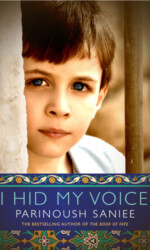
This is the story, based on fact, of a boy who couldn't speak till the age of 7. He is now 20 and describes the events of his life. Silence is often used by children as a way to protest. The child's physical disability creates a distance between him and others. His relationship with his father is particularly difficult. As he observes and compares his father's relationship with his older brother, he begins to believe that the 'good' and 'intelligent' children like his older brother are their fathers' sons. Children like him, who are 'clumsy' and 'problematic', are their mothers' sons. It is the love and understanding his grandmother gives him that finally gives him the courage to speak.
Roozbahan Iran
Garzanti Italy
Font Forlag Norway
Polirom Romania
Material: Iranian edition.